
Detroit’s Top 10 Worst Greatest Hits

Ten American 'performance' cars that arrived dressed for a street brawl but swung like a stoned mall cop.

American performance gave us tire smoke, big cams, and glorious confidence in horsepower. It also gave us a handful of machines that looked like speed, promised rebellion, and then showed up with the athleticism of a conference-room loveseat. The cars below earned their place through some combination of underpowered engines, compromised platforms, weird positioning, recall baggage, or marketing so delusional it should’ve required a wellness check
1971 Chevrolet Vega GT
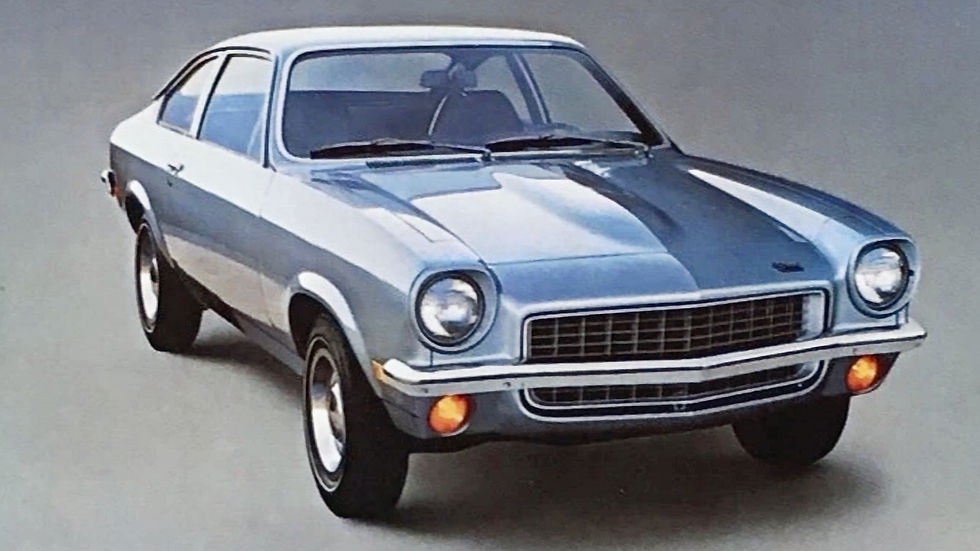
The Vega GT was GM’s attempt to make “sporty” happen in subcompact form, which would’ve been cute if the aluminum engine block hadn’t developed a reputation for overheating and warping while the body tried to rust itself back into the earth.
“The Vega GT proved you can, in fact, engineer disappointment to be lightweight,” said Miles Perhour, Self-Proclaimed Compression Ratio Philosopher.
This wasn’t a performance car. It was a long-form stress experiment disguised as transportation.
1982-1987 Dodge Charger

Nothing says “respect the heritage” like reviving the Charger name on a front-wheel-drive hatchback derived from Chrysler’s L-platform, with the early Charger 2.2 making a heroic 84 horsepower.
Cam Shaftson, Director of Heritage Mismanagement Studies, had a simpler way of putting it: “Calling this a Charger was like naming a toaster ‘Thunder Hammer.’”
This was a gym mirror hallucination with a VIN.
1982 Pontiac Firebird 2.5 "Iron Duke"

The third-gen Firebird looked sleek, but the base 1982 model came with the 90-hp Iron Duke four-cylinder, a powertrain so unfit for the body that the whole car felt like a movie poster with no film behind it.
“It looked like it should chase Camaros. It drove like it was late for a dentist appointment,” said Rusty Shackleford Jr., Senior Analyst of Underwhelming Horsepower.
A Firebird with the acceleration of municipal paperwork. Incredible.
1987 - 1993 Cadillac Allanté

Cadillac had bodies styled by Pininfarina and literally flown from Italy to Detroit, then bolted all that drama to a front-wheel-drive luxury roadster that cost over $60,000 and still failed to seriously dent the imported competition.
Leave it to Lug Nutley, Luxury Segment Delusion Consultant, to describe it as “A transatlantic masterpiece of asking the wrong customer the wrong question at the wrong price.”
The Allanté is what happens when a brand spends first-class money to arrive in coach.
2004 - 2008 Chrysler Crossfire

The Crossfire borrowed heavily from the Mercedes-Benz SLK recipe, but its polarizing styling and weak market reception turned it into the official sports car of “looked better in the pitch meeting.”
If Axle Greaseman, Freelance Panel Gap Theorist, nailed it with, “The rear end always looked like it was trying to apologize before you even drove it.”
Sales fell fast, and the car became shorthand for DaimlerChrysler weirdness. It looked like an art deco paperweight learned anxiety.
1984 - 1988 Pontiac Fiero

The Fiero was sold internally as an economical commuter in a sporty suit, launched with 93 horsepower, and later became infamous for recall and fire-related issues that permanently attached a question mark to its name.
Blake Rotor, Mid-Engine Risk Assessment Correspondent, didn’t exactly sound reassured: “The Fiero was the only car that made me nervous parking near dry leaves.”
A mid-engine American two-seater should’ve been a revolution. Instead, it became a cautionary tale in wedge form.
2003 - 2006 Chevrolet SSR

The SSR arrived as a retro-futurist convertible pickup with undeniable concept-car energy, but the early trucks paired a 300-hp 5.3-liter V8 with a 4,760-pound curb weight and a price tag that suggested something more ambitious than chrome-plated posing.
“The SSR was a hot rod designed by a gift shop,” as Clutch McRev, Acting Chair of Chrome Excess Studies, so elegantly put it.
It was a muscle truck for people who wanted to haul exactly one thing: attention.
1997, 1999 - 2002 Plymouth Prowler

The Prowler looked like a factory-built hot rod and used aluminum in fascinating ways, but enthusiasts roasted it for showing up with a V6, a four-speed automatic, no manual option, and the kind of performance mismatch that felt like a prank.
Tread Zeppelin, Performance Image Integrity Specialist, summed up the Prowler perfectly: “A thousand horsepower of attitude, 253 horsepower of follow-through.”
It’s the greatest example of a car whose appearance wrote checks the driveline filed for bankruptcy on - literally.
1980 Corvette California 305

Few crimes against heritage are as clean, efficient, and spiritually bleak as the California-only 1980 Corvette with a 180-hp 305 V8 and automatic only.
As Vinny L. Number, Smog-Era Trauma Historian, noted, “Owning one is like finding out your hero really just works in HR.”
That’s not a Corvette. That’s a fiberglass apology letter painted in disco puke.
And here it is — the grand champion of watered-down legacy, the stained monument to badge abuse, the very reason this list exists in the first place:
1974 Ford Mustang II

Yes, it sold. No, that doesn’t make it innocent. The Mustang II was a Pinto-derived downsized Mustang that launched without a V8, offering only four- and six-cylinder engines at first, and it remains the patron saint of badge misuse in the malaise era.
“The Mustang II didn’t kill performance; it just put it in a beige waiting room with bad coffee,” said Rod Caster, Beige-Era Performance Archivist.
This was the moment a proud nameplate got shrink-wrapped in compromise, wheeled into a fluorescent office, and told to smile for the quarterly forecast. Historians can defend the context all they want; context does not make this thing look any less like destiny got sent through Purchasing. I'm thinking this asshole is partially to blame for the Donk-E, err, Mach-E.
These weren’t just bad performance cars. They were organizational failures on wheels. The product of committees, compromises, nostalgia abuse, and marketing departments that confused visual drama with actual merit. Some are lovable now, some are collectible, and a few are weird enough to deserve a second look. But let’s not get cute: at launch, several of these things had all the credibility of a fake hood scoop at a dyno day.
The brochure promised excitement, screamed performance - even promised fireworks.. The actual experience? Yer bummin, Skip.

Nick "Car Sick" Cavanaugh | Editorial Dictator
The Fender Bender Garage


Comments